





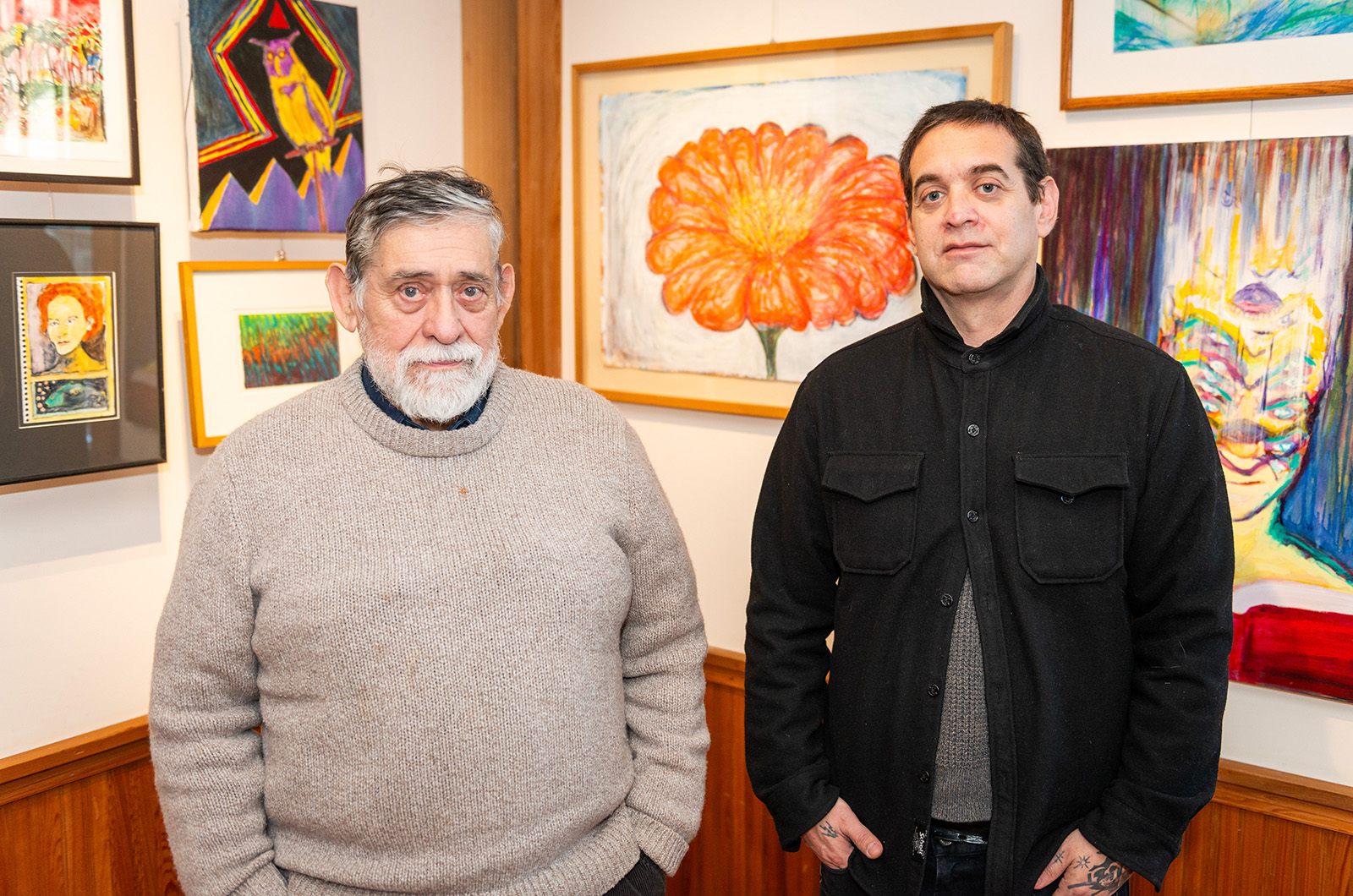
There are familial traits that highlight Vineyard artists Jaime Benavente and Diego Benavente as father and son: their light blue eyes, their reflexive humility.
Their paintings, on the other hand, could not be more different.
Jaime, 80, leans toward pensive landscapes and stately, impressionistic botanicals. His son Diego, 48, paints scenes dripping in technicolor that appear straight out of a sci-fi thriller.
But their shared exhibit, Encuentro — Spanish for “meeting” — puts their work in conversation in a way they never expected.

Plato’s Cave by Diego Benavente.
— Ray Ewing
“We didn’t plan it, but when it came about, it was like, yeah, sure, let’s do it,” Diego said of the collaborative exhibit, which ran at the Martha’s Vineyard Playhouse from October through December.
“And what a fun memory to create,” he continued.
Originally from Chile, the Benaventes now both live and create on the Vineyard full-time. Jaime has lived here for a decade, moving to Oak Bluffs after retiring to focus on his art. Diego, wanting to be near his father, followed three years ago and now works as a full-time artist and part-time carpenter.
But before moving to the Island, the Benaventes never lived in one place for very long.
Jaime’s primary career was not as an artist, but as a public health official and sociology professor. His work in public health took the family, including a young Diego, to “almost every” country in Latin America, eight countries in Africa and four in Asia.
Initially, Jaime picked up art as a hobby to offset his demanding career.
“When you do that, you have to have entertainment,” he said. “My entertainment was drawing and painting.”

The Benaventes are from Chile but have lived all over the world.
— Ray Ewing
Art quickly became a much-needed anchor for his peripatetic lifestyle. Using watercolor, acrylics and occasionally charcoal, he sought to capture the sights, sounds, joys and heartaches of the all places he temporarily called home.
His painting Northern Landscape depicts the Atacama Desert of his native Chile, the driest place on earth, where the sand meets the Pacific Ocean. A network of geometric lines creates the effect of dunes.
“I painted it as I was working in the south of Peru, north of Chile,” he said. “It’s a desert, but it’s beautiful, in some way.”
Some pieces, like Two Red Flowers, are more personal. Jaime painted the titular blooms, which emerge triumphantly from a planter of fanned out greenery, as a tribute to his daughter when she told him she was going to marry another woman.
The artistic reveal came as a surprise to Diego.
“I didn’t know that was about my sister and sister-in-law,” he said during the interview.
Despite having had an exhibition in New York some years ago, Jaime was quick to clarify that he does not consider himself a professional artist — not like his son, he said.
At nine or ten, Diego produced his first painting, depicting the view from the back window of his family’s apartment in Ecuador. He went on to study art at Hampshire College, work as a preparator (an art handler and installer) at the Guggenheim Museum in New York City, and travel the world assisting prominent artists.

The Benaventes now call the Vineyard home.
— Ray Ewing
But Diego waved off his extensive resume and his father’s praise.
“If you want to call [my career] professional, sure,” he said.
Today, Diego still finds creative inspiration from memories of his global upbringing. But central to his artistic ethos is the idea that memory is inherently incomplete — even hallucinatory. He said many of his pieces blend the real and the imagined.
“I treat my practice like a form of alchemy,” he said. “You’re really in the now when you’re painting, and you’re taking ideas and you’re making them into reality.”
Diego often approaches a canvas with intent to use “coded imagery” that draws on literature and philosophy. At the same time, he prefers to let viewers come up with their own ideas about what it means.
“I can’t control you and what you perceive,” he said. “In fact, I’m kind of interested in what you might see that I might not see.”
This conviction is embodied by Plato’s Cave, his acrylic painting interpreting the famous Platonic allegory about accepting illusion as reality. In form, it’s based on Caspar David Friedrich’s 1818 painting Wanderer above the Sea of Fog. This fact delights the art history buff in Jaime.
“I said, God, you are copying the most important kind of romantic painting in the history of art,” Jaime recalled.
Diego’s painting is a far cry from Friedrich’s sea of grays and blues. From the yawning mouth of a cave, his subject contemplates an electric horizon of pink, orange and yellow.
“I wanted a sunset or a sunrise,” Diego said. “That was the question, too: Is it a sunset or a sunrise?”
A piece called Spaghettification is named for the way a black hole’s gravity elongates matter. It depicts a figure bent over a book, wild-eyed with what could be fear or fascination. Frenetic brush strokes stretch his head and features toward the ceiling. Whether the figure’s mind is being expanded or destroyed, Diego said, is up to the viewer.
For him, the universe is of endless artistic fascination.
“I mean, there’s the fingerprints on my fingers, and then there’s the vastness of space,” he said. “It’s mind-blowing to me.”
For Diego, no amount of vastness, terrestrial or intergalactic, could change his fundamental identity.
“Wherever I go, I’m still me,” he said.
Jaime, ever the sociologist, quickly disagreed. For him, identity comes from having not just a place, but a community to which one irrevocably belongs — something he has struggled with, including on the Vineyard.
But there is the sense that the Benaventes will always belong to each other, no matter where in the world they find themselves.
“We’re not a traditional family,” Diego said. “But I think we’re traditional in our own way.”
link




More Stories
12 great-value holidays that will put a spring in your step
Top 10 Travel Blogs in the US to Inspire Your Next Adventure – ACS Vacations
Earlybird RV Show Opening this Week in British Columbia – RVBusiness