






Research process and subjects
To gain a deeper understanding of the respondents’ memories, feelings, and opinions about their own experiences, this research utilizes in-depth interviews. Qualitative research methods are necessary to explore the “why” behind the respondents’ experiences and obtain more complete information (Milena et al. 2008; Patton 2005). In-depth interviews are used with content analysis to collect interviewees’ opinions, views, and attitudes about a particular incident to gain a deeper understanding of the issue (Tsaur and Huang 2015). The three steps of content analysis, including dividing and condensing, coding, and establishing category and theme, are applied to improve the quality of inferences and provide an understanding of the knowledge and phenomena of the research (Downe‐Wamboldt 1992; Erlingsson and Brysiewicz 2017). Content analysis is also suitable for more difficult, special, and sensitive fields (Bogner et al. 2009).
Consequently, qualitative research was employed in the present study to gather pertinent information. Initially, the questionnaire for the in-depth interviews was designed based on previous research. The questions were subsequently revised after undergoing expert review, which involved four professionals: a cruise tourism expert, a travel agent, and two scholars specializing in tourism-related fields. The expert interviews aided in shaping the questionnaire for the subsequent stage of in-depth family interviews (please refer to Fig. 1 for the research framework flow). The experts were invited to review and modify the questionnaire, offering suggestions to enhance its design. Table 1 provides background information on the four experts.
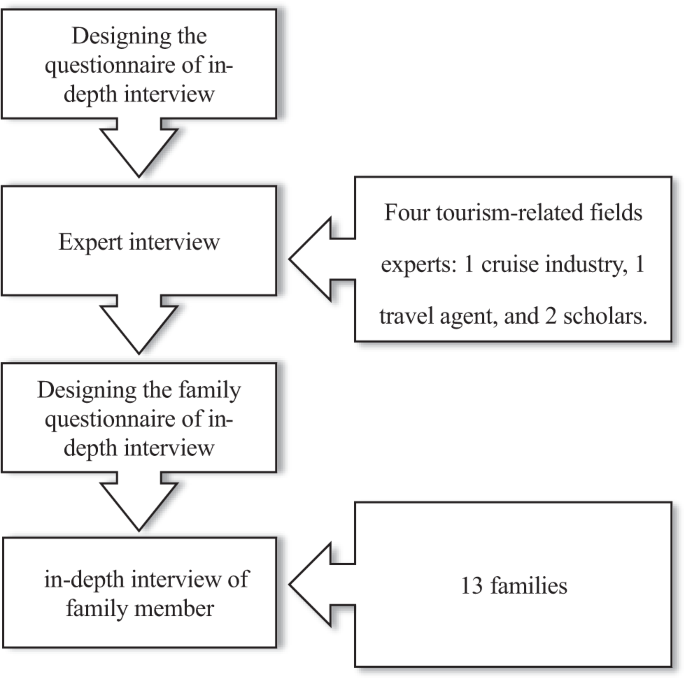
The research framework involved utilizing expert interviews to help formulate the questionnaire used in the subsequent phase of conducting in-depth family interviews.
Furthermore, to identify suitable cruise travel families for this study, the participants were primarily recruited through the following sources: (1) Families who had previously taken cruises were introduced to the researchers by experienced tour guides who had led cruise tours. (2) Qualified volunteers were invited from cruise travel Facebook communities. (3) Employing the snowball sampling method, the researchers reached out to families who had previously traveled on cruises through referrals from cruise travel agencies and interviewees who had organized cruise trips. The interviewed family members primarily consisted of those who had at least one experience of cruise travel and had traveled on cruises with their children. Only these families were selected as participants for this study.
A total of 13 families were interviewed to explore their motivations and experiences of cruise travel, while the dimensions of cruise tourism services were examined through a literature review. The initial scale was evaluated for content and face validity by the experts, all of whom held master’s degrees or higher education, with three of them having experience in leading family groups. The questionnaire for the in-depth family interviews was divided into three parts: “before (anticipation),” “during (participation),” and “after (recall)” of the cruise travel, in order to gain a comprehensive understanding of the respondents’ experiences.
Development of research questionnaires and data collection
Cruising is a mode of transportation that combines travel and lodging, offering a range of amenities, activities, and shore excursions (Sun et al. 2014). In recent years, there has been a surge in innovative facilities, routes, destinations, and exclusive experiences (Rodrigue and Notteboom 2013). In Asia, cruise tourism has gained popularity with great potential (Chen 2016). Theme cruises have emerged as a trend, and they can be categorized into three types: specific themes with onboard activities and arrangements, specific groups such as seniors and parent-child travelers, and charter boats where the itinerary is planned by a corporation or organization (Weaver 2011). Consequently, this research defines cruise travel as the use of cruises as the primary means of transportation, combined with lodging, dining, entertainment, and shore excursions.
Family travel involves the departure of at least two family members from their home for a period exceeding one day (Kennedy-Eden and Gretzel 2016). According to Gram (2005), the objective of family travel is to engage in collective activities, explore new destinations, and forge lasting memories as a family. Parents dedicate their time, effort, and finances to curate an unforgettable vacation experience for their children (Hilbrecht et al. 2008). As people live longer, the structure of families is undergoing vertical development, with grandparents increasingly developing strong bonds with their grandchildren, leading to a growing trend of traveling together (Schänzel and Yeoman 2015).
In Taiwan, the family composition has witnessed significant changes in recent times. Traditionally, Taiwanese families adhered to the nuclear family model, consisting of two parents and their children. However, social and economic factors have contributed to the evolution of family composition. Currently, the most prevalent family compositions in Taiwan include nuclear families, single-parent families, and multi-generational families comprising three generations (National Development Council 2023). Understanding the dynamics of family composition holds paramount importance in the context of family cruise travel for several reasons.
Firstly, tailored services are necessary to address the distinct needs and preferences associated with different family compositions. By comprehending the family composition within their target market, cruise operators can customize their offerings and amenities to cater to the specific requirements of each family type. For instance, single-parent families may benefit from accommodations designed for smaller groups or specialized activities tailored to their needs. Secondly, accommodation considerations play a crucial role, as family cruise ships must provide suitable lodging options for families with varying compositions. This may involve offering larger cabins or connecting rooms to accommodate nuclear families or multi-generational families. Understanding the family composition assists cruise operators in allocating resources and designing accommodations accordingly.
Thirdly, activity planning should take into account the diverse interests and preferences of different family compositions, both onboard and during shore excursions. By considering the family composition, cruise operators can provide a wide range of activities and experiences that cater to the specific needs and desires of each family type. This ensures the participation and enjoyment of all family members throughout the cruise. Lastly, pricing and package strategies can be tailored based on family composition. For instance, family packages may include discounts for children or special rates for single parents. Understanding the family composition enables cruise operators to develop pricing strategies that appeal to different family types and maximize their market reach.
Consequently, comprehending the family composition in Taiwan is of great significance in the realm of family cruise travel, as it empowers cruise operators to offer customized services, appropriate accommodations, diverse activities, and suitable pricing structures for various family types. By addressing the specific needs and preferences associated with each family composition, cruise operators can enhance the overall travel experience and attract a broader spectrum of family travelers. Furthermore, within the context of this research, a family traveler is defined as a parent or single parent who brings at least one child under the age of 18, with or without the inclusion of grandparents. The travel experience, as defined by this research, encompasses the various encounters tourists face at different stages of their trip (Radic 2019). Considering the nature of cruise travel, this research divides the travel experience into three stages: the anticipation stage prior to boarding the cruise, the cruise participation stage, and the recall stage. Hence, travel experience is delineated as the three stages of the travel journey, allowing for an examination of distinct experiences at each stage.
Three stages of cruise travel experience
The interview questions for this study are based on Hung and Petrick’s (2011) research, which identified four categories of motivation for cruise travel: self-esteem and social recognition, escape and relaxation, learning, discovery, and thrill, and bonding. The study focuses on the three stages of cruise travel experience: anticipation, participation, and recall, drawing on Juan and Chen’s (2011) exploration of Taiwanese cruise passengers’ behavior at different stages, the factors influencing cruise vacation decisions (Bahja et al. 2018), and research on children’s cruise experiences (Radic 2019).
In the anticipation stage, Juan and Chen (2011) found that price, trip duration, desires of companions, activities, and facilities were the main determinants of cruise trip selection. However, as this study focuses on family travel, desires of companions were modified to desires of family members. Bahja et al. (2018) examined the relative importance of six factors in cruise customers’ decision-making process: cruise vacation price, duration, distance from the cruise port, itinerary, environmental friendliness of the cruise line, and online reviews. Radic (2019) found that cruise brand, activities, and ports of call were significant considerations for tourists. Consistent with these studies, the factors considered by cruise tourists in this study were price, number of days, cruise brand, activities, equipment, itinerary (port of call and destination), family members’ desires, and online reviews of cruise ships. The study further explores the differences in family members’ considerations for cruise travel during the anticipation and recall stages.
Service dimensions during the cruise travel experience stages
Drawing on previous research on group package travel (Wang et al. 2000), Taiwanese cruise travelers’ behavior at different experience stages (Juan and Chen 2011), cruise experience (Hwang and Han 2014), and factors influencing Taiwanese women’s choice of cruise travel (Chen et al. 2019), the study developed 11 in-depth interview questions. These questions cover a range of aspects such as cruise characteristics, cabins, restaurants, facilities, entertainment activities, tour guides, shopping, exclusive activities for children, work teams, self-financed activities, and other relevant factors.
The experts have revised the questions, resulting in the following dimensions of motivation. For the motivation dimension of self-esteem and social recognition, the aspects are as follows: 1. Impress others; 2. Receive high praise from others; 3. Feel like a better person; 4. Obtain a high-quality vacation; 5. Enhance self-worth; 6. Achieve a sense of accomplishment; 7. Capture exotic photos to show off to friends. For the motivation dimension of escape and relaxation, the aspects are as follows: 1. Have fun; 2. Enjoy the freedom to do what I want; 3. Escape from everyday life; 4. Relax physically and mentally. For the motivation dimension of learning/discovery and novelty/excitement, the aspects are as follows: 1. Enjoy nature; 2. Gain knowledge; 3. Experience other cultures; 4. Enjoy exciting activities. For the motivation dimension of socialization, the aspects are as follows: 1. Make new friends; 2. Meet different people. For the motivation dimension of interpersonal connection, the aspects are as follows: 1. My friends or family members want to go on a cruise travel; 2. I can interact with my friends or family members during the trip.
The experts made several modifications to the factors that influence customers’ choices in the anticipation and recall stages. These factors include price, duration of travel, cruise brand, activities, cruise equipment, cruise itinerary (destination and ports of call), family members’ desire for cruise travel, online reviews, and travel agency. Cruise reviews, including online reviews, newspapers, magazines, and word of mouth, replaced online reviews. In the participation stage, the experts recommended that cruise tonnage be used as a reference criterion for cruise features, and added court and cinema to facilities, friendliness to tour leaders as an important consideration, and duty-free shopping to the shopping section. The service enthusiasm of the service team was also added as a criterion. The experts also proposed two types of briefing for tourists, one for participation in activities at their own expense and another for the introduction to tourist attractions and transportation from the pier to the tourist attractions. Based on these modifications, the experts suggested some service dimensions for the participation stage that would be further explored in the follow-up in-depth interviews.
link




More Stories
30% of Japanese people are interested in domestic dual-residence, selecting a preferred travel destination within 90 minutes from home
Connections launches debut ‘Explore Hungary’ event
Elevating Japanese Exploration: Nippon Travel Agency Debuts Customizable ‘Akai Fusen Select’ for Tailored Domestic Travel