





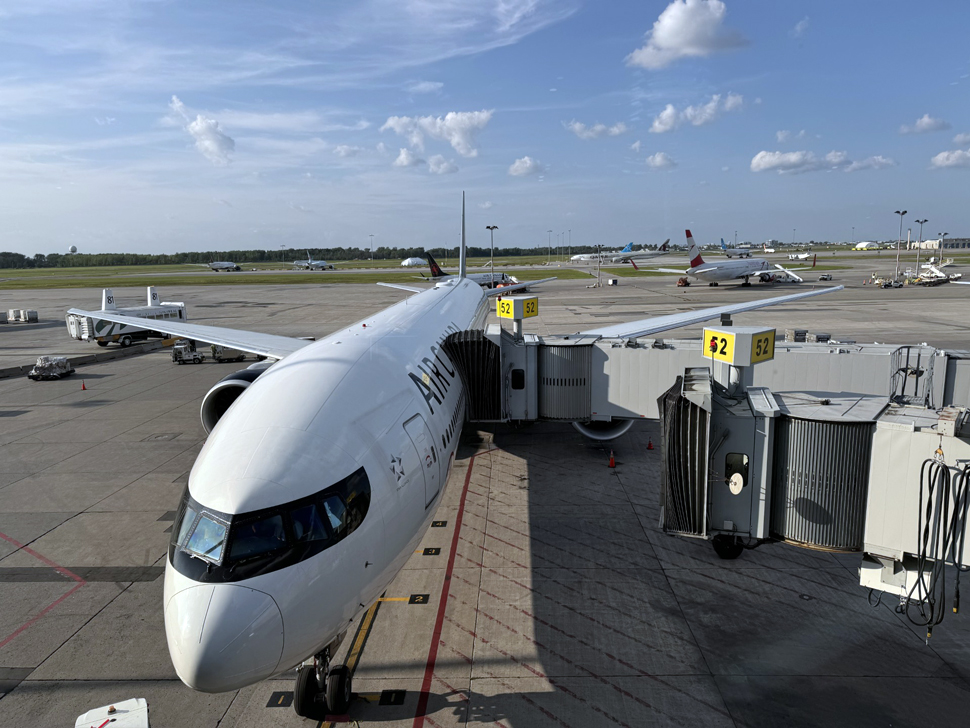
A local travel agent says the political climate in other countries is definitely impacting the vacation plans of Southern Manitobans.
Mary Jane Hiebert owns Oyster Travel Services in Steinbach. She says her clients are avoiding locations near Venezuela, such as Honduras and Aruba. Earlier this month, the United States launched a military strike on Venezuela, capturing its President. Hiebert says Manitoba does not have direct flights to Aruba anyway, and so there is generally less travel to that country.
Hiebert says people are also avoiding Cuba these days, but that is for a variety of reasons. First of all, she says resorts in Cuba are owned by Russian enterprises, with supplies coming from Russia. Hiebert says Cuba has had electrical deficiencies where the entire country goes black, and the island is also suffering from a lack of water.
According to Hiebert, there is also a trend of Canadians avoiding travel to the United States, and recent statistics from Canada Border Services Agency (CBSA) would back that up. CBSA has provided us with their most recent stats from the week of January 4-10. It shows that air travel by Canadians from the United States was down more than 12 per cent that week from the same week in 2025. It shows air travel by Canadians flying through the United States was down two per cent during that time.
The decline in land travel is even greater. CBSA says that the week of January 4-10, 2026, saw a 20 per cent drop in Canadians entering a land crossing from the United States. The numbers are compared to the same week in 2025.
“There is definitely a trend to avoid the United States altogether,” says Hiebert. “People don’t want to be routed via the United States if at all possible.”
Hiebert says she has Canadian friends who have been detained in the U.S.
Hiebert notes the airlines have responded by reducing the number of flights between the two countries by at least 20 per cent, the last two years.
According to Hiebert, she feels the reason why Canadians are avoiding the U.S. has less to do with safety concerns and more to do with an outright boycott. She says the reasons have probably changed since President Donald Trump’s first term in office, noting back then, reasons may have had more to do with fear among Canadians, while today they may have more to do with uncertainty.
“I absolutely have friends who travelled to the United States the first time around, and now it’s a total boycott,” she clarifies.
But just because travel is down to the U.S., Hiebert says that does not mean that Canadians are not finding alternate places to vacation. She feels that Canadians are using this as an opportunity to visit more of their home country, which Hiebert says is wonderful.
 Lake Louise continues to be a popular spot for tourists.
 “West coast is always very popular, especially if you are a skier, you are going to Whistler or Banff,” says Hiebert. “But I think that there is more of a trend to go see the eastern part of Canada.”
Hiebert says eastern Canada is generally not travelled to as much, because it tends to be a little tougher to get to, and therefore a little bit more expensive. However, Hiebert says if you do not want to travel as far as Europe, you can get some of that European experience in the eastern part of Canada.
As for popular places right now in Europe, Hiebert says London is always a hot spot because it is easy to get to and it is an English-speaking city. She adds European river cruises are very popular because they offer a wonderful way to see a lot of Europe in a short period of time, without needing to unpack.
Hiebert says Asia also has popular travel destinations right now, including Thailand and Japan.
As far as hot destinations this winter, Hiebert says Mexico will forever be popular because of the ease to travel there, and the weather is basically guaranteed. She notes there are numerous flights out of Winnipeg each week to Puerto Vallarta and Cancun.
Meanwhile, Hiebert says those travelling to Europe should be aware of some changes that were recently introduced. Hiebert says since about September of last year, those travelling to or through London, Scotland, and Ireland need an electronic Visa. Some of the documentation that is required as part of this includes a photo, a copy of your passport, employment history and a small fee. Hiebert says at some point in 2026, this electronic Visa will be necessary for all travel to Europe.
According to Hiebert, she can currently get the Visa processed within about 24 hours. However, once the entire European Union has this requirement, Hiebert suggests that it might take a little bit more time to process. She says travellers should give themselves at least seven days to get the documentation together.
link




More Stories
Laptop prices could jump dramatically this year as RAM shortages and rising CPU costs squeeze notebook makers worldwide
Loblaw confirms data breach – Canadian retail giant says ‘basic customer information’ affected
How to Make a Killing review: a serial killer story should not be this boring